
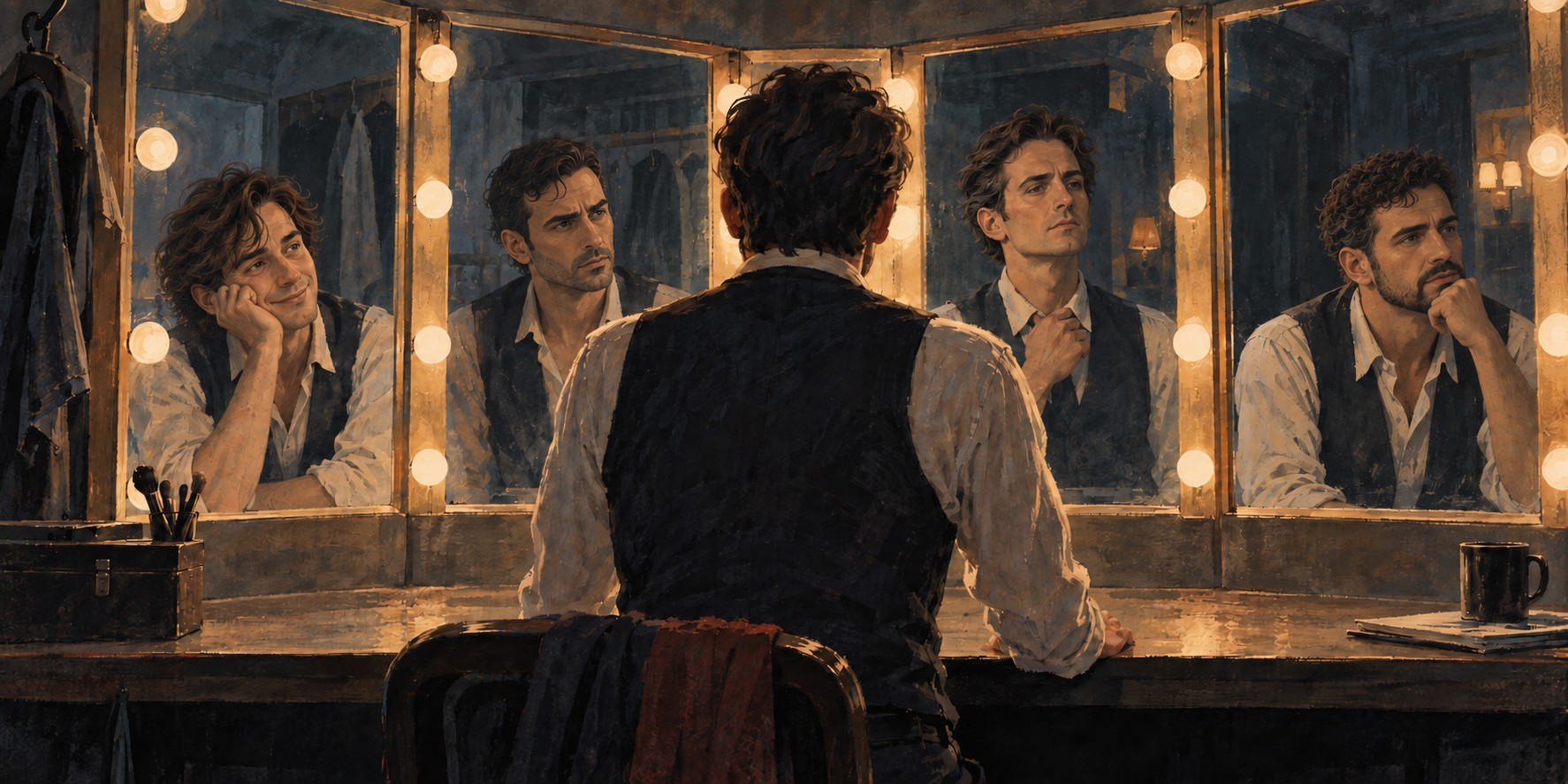
An actor told me that after going on dozens of auditions, he noticed a pattern. The same guys were competing for the same roles again and again, and they all knew each other. He slowly developed rivalrous friendships with them, and during a conversation with one of them, a strange insight appeared: “This is what I look like.”
Artists strive for originality, but this moment revealed that, in the eyes of others, he was more interchangeable than he’d imagined. No matter how unique he believed himself to be, the world had another point of view. The recognition was painful and impossible to ignore.
What retrospectively feels like self-knowledge often begins as an observation about us that we unexpectedly intercept. The interruption can be embarrassing, disturbing the egocentric narrative we hold dear. We are locked into the limits of our own position, while other people encounter versions of us we cannot see from within. Such moments make us briefly unfamiliar to ourselves. They remind us that other people carry versions of us that we may never encounter.
The Story of Me
In the process of living it, life is messy and contingent; in retrospect we find themes, self-discovery, and perhaps redemption. We are compelled to reduce a sprawling life into a hero’s journey, thereby making the self feel knowable. Out of ambiguity we extract an artificial certainty, often telling ourselves some version of this: “I was an idiot until about two years ago.”
Because we continue to change, our narration always lags slightly behind experience, which revises the story faster than we can tell it. Yet we narrate each new version of ourselves as the final manuscript.
We tell these stories to make ourselves legible, and legibility helps us connect with other people. But over time, what exceeds the story may prove more interesting than what fits inside it. We usually encounter that excess through someone else’s eyes.
Living Questions
A scientist told me that hiring for his research lab was surprisingly difficult, despite the lab’s elite reputation. He was mostly interviewing impressively pedigreed PhDs, but it turned out that encyclopedic knowledge wasn’t the essential criterion. For him, the most important factor was the capacity to ask an interesting question.
Knowing something well does not mean running out of things to know, but people who believe they possess all the answers present a smooth, polished surface that deflects unwelcome observations. The fantasy of completeness makes us harder to reach.
As the certainty of the hero’s journey begins to yield, the story becomes less definitive, and we become more like living questions, open to alternative points of view. Surprising possibilities emerge when our attention moves from the known to the unknown, and another person inadvertently reveals to us something we couldn’t have seen without them. Expertise does not exhaust its subject, and familiarity does not exhaust a person.
The Disruption of a Relationship
Familiarity never becomes complete. In a long-term relationship, your partner experiences you from a position you cannot occupy. From that vantage point, they occasionally alert you to unfamiliar, and at times unpleasant, dimensions of yourself.
We tend to frame a relationship as a shelter from the difficulties of the world, but this doesn’t fully capture it. A compelling self-narrative offers another kind of shelter, enclosing us within a stable account of who we are. Intimate relationships can threaten that stability by continually frustrating self-certainty. They burden and limit us, but we pursue them in part because they enliven.
Your partner may see things about you that you don’t recognize, and may even love you for things you don’t want to know about yourself. Sometimes I’ll offer an observation that strikes me as goofy and pedantic, only to notice that my wife seems to take some joy in it. What I dismiss as annoying, she seems to experience quite differently, and so I continue—perhaps to the point of actually being annoying. If your partner loves something that is not included in your sense of self, who (or what) is it that they love?
You cannot fully see what your partner sees. As they reveal how differently you appear in their eyes, you become at once more visible and more obscure to yourself. You return the favor, not by revealing some essential hidden truth, but by enjoying versions of them that their own story can’t contain. Neither perspective is definitive. Yet through another person’s eyes, each of you sometimes catches a glimpse of what remains invisible from within: This is what I look like.